Annual ETS Review
The following reports and briefings have been produced thanks to the support of our core funders: The European Climate Foundation, the Goldsmith Foundation and the Esmee Fairbairn Foundation.
A full list of our published reports can be found here.
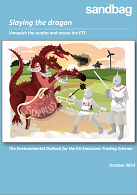
In our 6th annual report, Slaying the Dragon, we highlight the effect of recent changes to the ETS rules. There have been big improvements from an environmental perspective – including harmonised cap setting, the introduction of carbon-efficiency benchmarks and the banning of certain classes of offsets.
Our report finds that changes introduced to date, though welcome, are not sufficient to address the ETS’s significant problems, the most obvious of which is the build up of a massive excess of allowances that is suppressing prices and dissuading companies from investing in clean technology.
With a new team in Brussels there is great potential to get the ETS back on track. Vanquishing the surplus should be the first item on the to-do-list, but positively addressing competitiveness fears, by ensuring ETS rules stimulate green growth in Europe, must also be a part of that process.
Drifting Toward Disaster is Sandbag’s 5th Annual Environmental Outlook for the EU, reviewing how the scheme has performed across the whole of its second trading phase. The report finds that the Emissions Trading Scheme stands to deliver less than zero net emissions reductions over 2008-2020, and is cancelling out abatement from other policies in the climate package to count against its future climate pledges. It encourages policymakers to agree a backloading decision as a stepping stone to structural reforms which increase the ambition of Europe’s 2020 targets and its forthcoming pledges in the international climate negotiations.
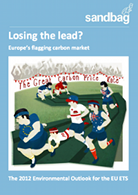
Losing the lead is Sandbag’s 4th annual report on the Environmental Outlook for the EU ETS – following on from ETS S.O.S. (2009), Cap or Trap? (2010) and Buckle Up! (2011). This report again uses latest emissions data to examine how the ETS is performing on the ground and makes recommendations for urgent reforms. In particular, it highlights that existing proposals to reform the scheme inadequately account for the change in demand for allowances since the caps were last set (2.2Gt), and the effects of industrial overallocation on the cap (0.9Gt). This report also updates our list of Carbon Fatcat companies accruing the largest surpluses of free allowances within the scheme.
21st Jun: RECHARGE
21st Jun: Environmental-Finance
20th Jun: Business Week
20th Jun: Bloomberg
20th Jun: Platts
20th Jun: The Parliament
20th Jun: Point Carbon